Vehicles Manager
Trends in Fleet Management 2026: What Small Yards Must Fix
The biggest trends in fleet management in 2026 are rising costs, telematics as the baseline, and fast EV-driven market growth. But for a 10–60 vehicle yard, the trend that bites first is simpler: knowing at 06:00 which vehicle may actually leave. GPS shows where a van is. It does not show that it was marked 'shop' last night. Larger fleets bought tools to close that gap. Small contractor and rental yards still run it on a spreadsheet and a WhatsApp thread. That is where 2026 gets expensive.
Quick Answer: Three Shifts Define Fleet Management in 2026
Fleet management trends in 2026 come down to cost pressure, connected hardware, and electrification. For small yards, the actionable shift is closing the readiness gap before the morning roll-out. A live readiness board for small fleets replaces the spreadsheet fight at a live readiness board for small fleets.
- Rising Costs [2026 Data]: Over half of fleet managers now rank cost as their top concern, squeezing small yards that still run on manual tracking.
- Telematics Baseline [2026 Data]: Connected vehicles are now standard, but GPS location cannot tell you if a van is cleared to leave the yard.
- EV Market Growth [2026 Data]: Electrification drives complexity, adding charging status to the morning check but only if you know which vehicles are ready.

Rising Costs Are Forcing Small Fleets to Stop Paying for Mistakes
Cost pressure is not a forecast in 2026. It is a payroll line item. According to Fleetio, the 2026 Fleet Management survey found that 54.4% of fleet managers identified rising costs as their primary concern. Parts, labor, and downtime are all up. For a small yard, the mistake that hurts most is sending a van that was already marked "in shop."
This burns a full crew day. The crew loads up, heads to the site, and gets half the job done before the van dies or before the shop calls asking why their patient left. Now you are paying for the call-back, the rushed repair, and the wasted morning. That is real money. At $2.99 per vehicle, a readiness board pays for itself the first time it stops one bad dispatch.
- Idle crew: Three workers stand around waiting because the van they were assigned is not roadworthy.
- Missed booking: A rental customer arrives, but the car they reserved is on a lift with no wheels.
- Rushed repair: The shop takes shortcuts to get a unit back out, creating a bigger failure next week.
- Double handover: Two people hand over the same keys, and no one knows who actually has the vehicle.
These failures do not show up in a monthly GPS report. They show up at 06:15 when the dispatcher realizes the board was wrong. The spreadsheet does not update itself. The WhatsApp group has three different statuses for the same unit. Costs rise because the information is stale before the coffee is cold.
Telematics Is Now the Baseline. It Still Can't Tell You a Van Is Grounded
Connected vehicles are the new normal. As reported by Volpis, telematics and connected vehicles became the baseline in fleet management by 2026, with hardware standard on almost every new commercial unit. The Verizon Connect Fleet Technology Trends report confirms it. If you buy a van this year, it ships with a GPS chip. That is useful. It tells you where the van is right now.
It does not tell you whether that van is allowed to leave. For contractor fleets, the critical question is not "Where is unit 204?" The question is "Is unit 204 safe to put a crew in this morning?" Telematics answers the first. A readiness board answers the second.
| What GPS/Telematics Answers | What a Readiness Board Answers |
|---|---|
| Current location (latitude/longitude) | Current status (ready/shop/next service) |
| Last known ignition state | Whether the shop cleared it for duty |
| Speed and heading | Which driver took the keys |
| Geofence boundary crossing | Whether the booking calendar matches the key hook |
| Fuel level or battery charge | Whether inspection is due this week |
GPS is a map. A readiness board is a decision. The gap is not about tracking. It is about permission. When the yard manager is out sick, the spreadsheet lives in their head. The GPS dashboard lives in the cloud. Neither one tells the dispatcher, "This van failed inspection yesterday. Do not send it."
A Market Heading Toward $153 Billion Is Not Built for 12-Van Yards
The global fleet management market is on a steep trajectory. According to Scottmax, the market is projected to expand from $32.24 billion in 2025 to $153.3 billion by 2035. That is nearly a five-fold increase in a decade. EV adoption fuels part of that growth as fleets add charging infrastructure and battery-health monitoring. Complexity is increasing. Software vendors are chasing it.
[Study] The global fleet management market is projected to grow from $32.24 billion in 2025 to $153.3 billion by 2035, representing a compound annual growth rate that reshapes vendor priorities.
That growth sounds like opportunity. For a 12-van yard, it feels like a mismatch. Enterprise software is built for scale. It offers routing optimization, predictive maintenance, and driver-score cards. It promises insights. It requires multi-year contracts, hardware installations, and IT onboarding. It solves problems a small contractor fleet does not yet have.
The trades and service fleets running 10 to 60 units do not need a dashboard that predicts next quarter's brake wear. They need to know if the van with the brake problem left the yard this morning. The market is growing toward big-fleet problems. Small yards are still stuck with the spreadsheet. The tools that scale skip the yards that cannot afford a three-year GPS contract.
The Spreadsheet-and-WhatsApp Morning Board Is the Trend Nobody Reports
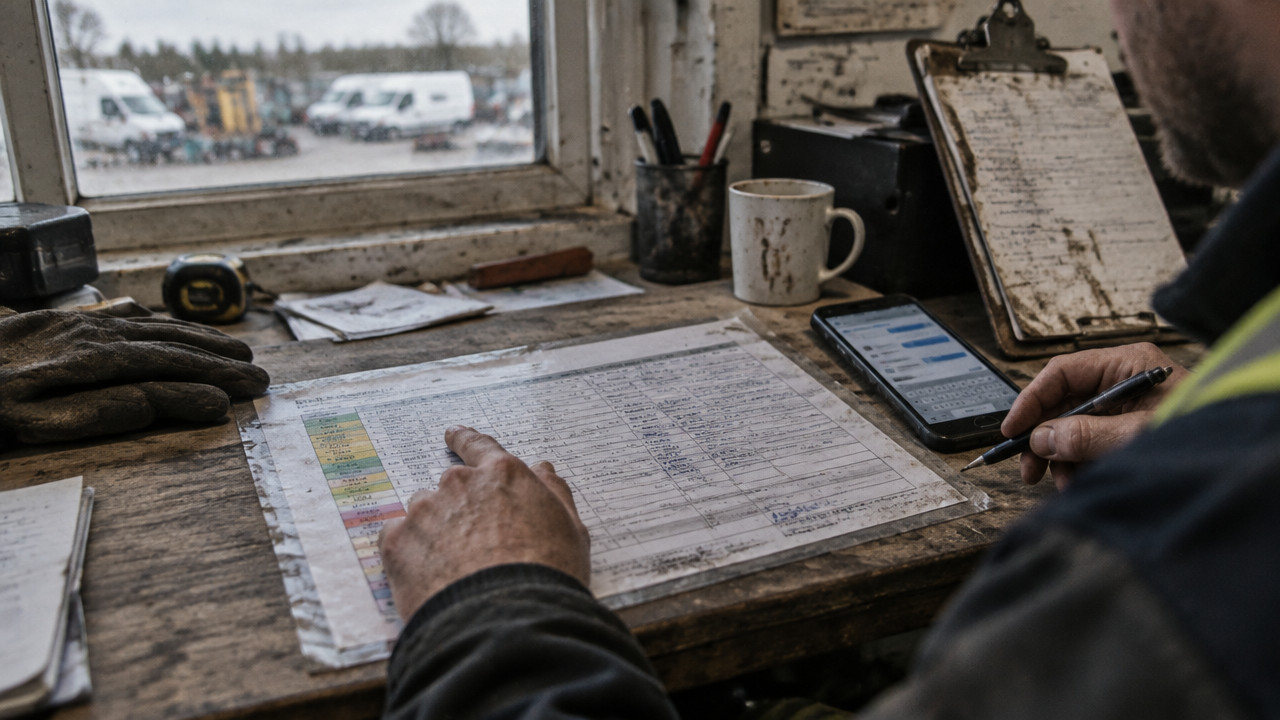
This is not a trend in the analyst reports. It is the reality in the yard. At 06:00, the morning board lives in a spreadsheet. The status column says "ready." The WhatsApp thread says "shop." Two people updated the same row at different times. No one noticed. Dispatch sends the van anyway. The crew is halfway to the job site when the shop supervisor calls: "Why is unit 1188 gone? We have the transmission out."
On rental lots, the failure looks different. The booking calendar says the silver sedan is reserved for a 09:00 pickup. The key hook is empty. The service log on someone's desk says the car needs a new alternator. By lunch, a customer is angry, a mechanic is rushing, and the lot manager is explaining why a broken car went out. The spreadsheet is unmanageable. The chat thread is worse.
- Stale file: The last saved version is two days old; no one refreshed it before roll-out.
- Chat mismatch: WhatsApp shows "ready" at 05:45 and "shop" at 06:10 but the dispatcher only saw the first message.
- Absent sheet owner: The yard manager is on vacation; no one else knows which tab has the real data.
- Shop silence: The mechanic marked the unit down in their head, never updated the row.
- Key hook: The physical keys are in the wrong place, and the digital status does not match.
This is not a technology gap. It is a communication gap. The information exists. It lives in three places, none of which talk to each other. The result is conflict, delay, and cost. The solution is not GPS. It is one shared board that shows the truth before the keys move.
How to Build a One-Row-Per-Vehicle Board in 15 Minutes
Small yards do not need a database project. They need a board. The setup takes about 15 minutes. You do not install hardware, sign a multi-year contract, or integrate with GPS. You paste the list and set the states. This is how you stop the 06:00 conflict.
- Paste the vehicle list: Copy the unit IDs, descriptions, and current locations from your existing sheet or yard inventory.
- Set three states only: Ready, Shop, Next Service. No complex codes, no custom fields just the status that matters at roll-out.
- Assign editors: Give the yard manager, the shop lead, and dispatch access. Each person updates their own domain.
- Verify the first morning: Before the first crew leaves, walk the lot once. Match the board to the keys. Fix any mismatches.
- Lock the habit: Make the board the single source of truth. If it is not on the board, the van does not leave.
That is the check. One row. Three states. One shared view. Whether you run per-department municipal boards or a single contractor lot, the principle is the same. If the spreadsheet says ready but the board says shop, the board wins. The crew waits. The conflict ends before it starts.
Key Takeaways: What to Act on Before Next Monday's 06:00 Roll-Out
The trends in fleet management for 2026 are real. Rising costs force every yard to cut waste. Telematics is standard it tells you where, not whether. The market is growing but small yards are underserved by big-fleet tools. The readiness gap is where you lose money. Close it. No GPS. No hardware installation. No contract locking you in for years.
- Cost pressure leads: Over half of fleet managers cite rising costs stop paying for avoidable dispatch mistakes.
- GPS is not readiness: Location data cannot tell you if a van was cleared by the shop this morning.
- The market skips you: $153 billion in growth targets enterprise fleets, not the 12-van contractor yard.
- Excel is killing you: The spreadsheet-and-WhatsApp combo creates more conflicts than it solves.
- One board fixes it: A shared readiness view stops the 06:00 dispatch error before the tires hit the gate.
This is not theory. It is Monday morning. The crew is waiting. The board either says ready or it says shop. Shuttle and minibus fleets and rental lots face the same gap. The question is whether you see it before the van leaves.
FAQ: Fleet Trends, GPS Contracts, and Retiring the Sheet
What are the top fleet management trends in 2026?
Three trends lead: cost pressure, telematics as baseline, and EV-driven market growth. A 2026 survey notes: Over 54% of fleet managers rank rising costs as their top concern. Takeaway: Small yards must cut waste starting with dispatch errors stemming from stale data.
Do I need GPS to run a readiness board?
No. Readiness tracking answers: whether a vehicle is cleared to leave, not where it is located. GPS contracts: often lock yards into multi-year terms and hardware installs they do not need. Takeaway: A status board closes the dispatch gap without telematics.
How does EV adoption change small fleet management?
It adds charging status. EVs require: a new check item battery charge and charging-slot availability alongside fuel levels. Market projection: The fleet management sector grows five-fold by 2035, driven partly by electrification. Takeaway: EVs increase complexity; the readiness board must track charge state, not just maintenance.
When does the spreadsheet-and-WhatsApp combo stop working?
Around 10 vehicles. Failure points: stale files, chat mismatches, absent owners, and shop silence multiply with every added unit. Yards report: "Excel is killing me" once the fleet cannot fit in one person's head. Takeaway: If two people can disagree about a van's status at 06:00, your system has failed.
Is a readiness board worth it for a small fleet?
Yes, if you dispatch vehicles daily. Cost: at $2.99 per vehicle, one prevented mistake covers months of subscription. Bad fit: one-car owners or fleets needing routing optimization. Takeaway: If you have landscaping crews waiting on morning keys, a board pays for itself the first week.
Fri Oct 30 · Editorial Team