Vehicles Manager
Fleet Management Policy for Small Fleets: a 2026 Guide
A fleet management policy is a short written rulebook that says who can mark a vehicle ready, who can send it to the shop, and what must be true before it leaves the yard. For a 10–60 vehicle fleet, it fits on one page. The policy fails when it lives in a spreadsheet and a WhatsApp thread, because two people mark the same van 'ready' and 'in shop' at 06:00. Write three states, one owner per state, and one board everyone reads. That is the whole policy.
Quick Answer: A Fleet Policy Is Three States, Three Owners, One Source of Truth
A fleet management policy for a small operation defines exactly three vehicle states: ready, shop, and next service. Each state has one named owner who can change it. The policy exists to stop the morning conflict where dispatch sends a van that the shop already marked down for repairs. It is not a fifty-page document. It is one page, one board, and clear authority.
- Ready: The vehicle can leave the yard. The yard manager or dispatch owns this state.
- Shop: The vehicle is in repairs or awaiting parts. The shop manager owns this state.
- Next Service: The vehicle is operational but due for scheduled maintenance. The service advisor owns this state.

Small fleets under 50 vehicles make up roughly 85% of US commercial fleets, which means most fleets run on informal systems rather than enterprise software. According to Spytec, small fleets under 50 vehicles make up roughly 85% of US commercial fleets, which means most fleet policy is written for the wrong scale. Spytec The gap is not tracking. The gap is authority. A vehicle readiness policy works when everyone looks at one live readiness board per fleet instead of checking their phones for the latest WhatsApp update.
The Six Clauses a 10–60 Vehicle Policy Actually Needs (and the Ten You Can Skip)
Most fleet policy template documents are built for fleets with compliance departments and legal teams. A 10–60 vehicle operation does not need clauses about telematics scoring, fuel card fraud prevention, or ERP integration. Those clauses get ignored. What works is a short document that names the six rules that actually matter on the yard at 06:00.
| Clause | What It Says | Who Owns It |
|---|---|---|
| Status Definitions | Ready means cleared to dispatch. Shop means no dispatch. Next service means cleared but scheduled. | Owner or Yard Manager |
| Ownership | Only the named owner can change a vehicle's status. | Owner |
| Inspection Trigger | A vehicle enters shop status when a defect is reported or inspection fails. | Shop Manager |
| Service Interval | Vehicles move to 'next service' based on mileage or date, not guesswork. | Service Advisor |
| Release Rule | A unit marked 'shop' cannot be dispatched until the shop owner changes status to ready. | Dispatch |
| Escalation | If status is unclear at 06:00, the yard manager makes the call, not the driver. | Yard Manager |
Skip the clauses about fuel cards, GPS driver scoring, accident reporting forms, and vehicle spec sheets. Those belong in an employee handbook or a vendor contract. A fleet maintenance policy for a small yard needs to fit on the wall next to the exit gate. If it is longer than one page, the crew will not read it. This is especially true for trades crews running vans and service trucks who need answers in seconds, not paragraphs.
Why the Spreadsheet-and-WhatsApp Policy Breaks at 06:00
The small fleet operations rules that work at 08:00 fall apart at 06:00. The sun is not up. The yard manager is on the phone. The spreadsheet lives on one laptop that is still in the truck. The WhatsApp thread has seventy unread messages. In that moment, dispatch makes a decision based on memory or the last status they saw. That is when a van marked 'shop' gets dispatched anyway.
- Two people mark the same van 'ready' and 'in shop' at the same time, and dispatch sends it.
- The spreadsheet owner is out sick, so no one knows which units are cleared to leave.
- The WhatsApp thread scrolls past the shop update, and dispatch misses it in the morning rush.
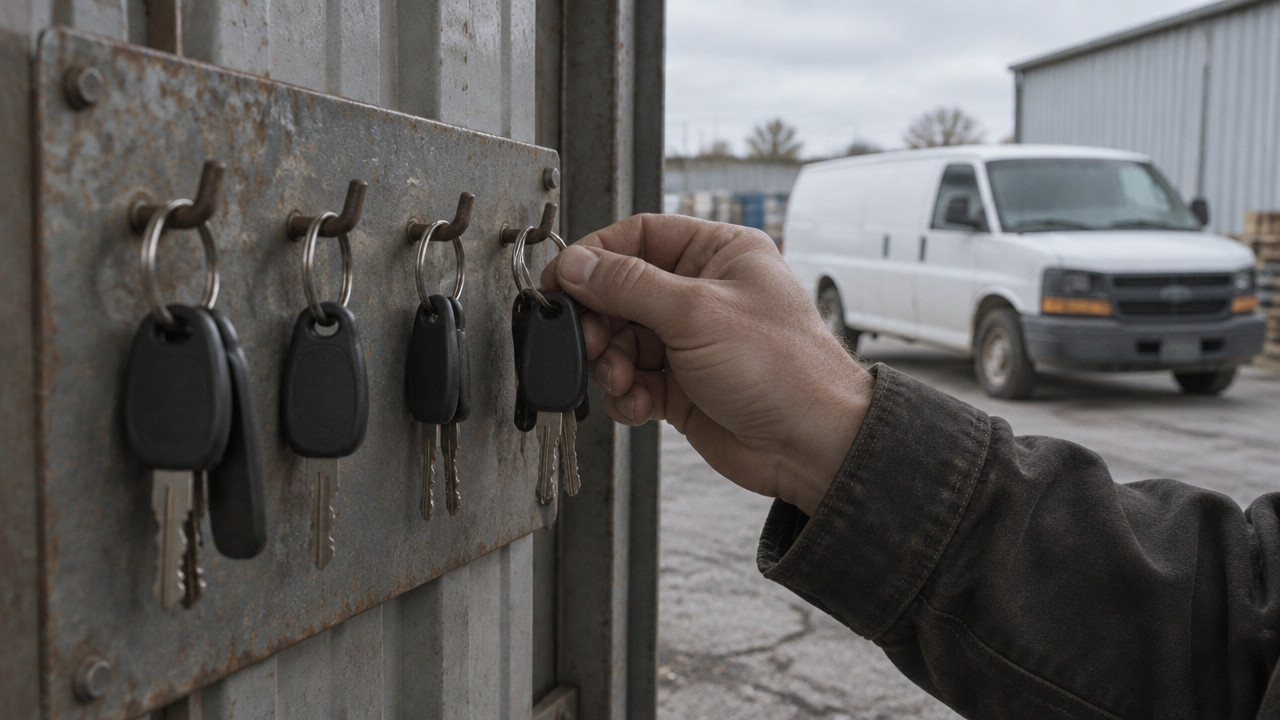
- The rental booking calendar says the car is available, but the keys are on the shop hook.
The real cost is not the confusion. The cost is the breakdown that happens an hour later when the driver calls in stranded, or the customer shows up for a rental that is not there. These are the rental lots where the calendar and key hook disagree by lunch. A vehicle status tracking system that lives in a file or a chat thread is not a system. It is a bet that nothing will go wrong at the exact moment everything goes wrong.
How to Write Your Fleet Management Policy in One Afternoon
Writing a fleet management policy does not require a consultant. It requires a quiet hour, a list of your units, and a decision about who owns each status. The policy is not the document. The policy is the agreement about who gets to say 'go.'
- List every vehicle in your fleet by unit number, not by license plate. Keep it to one row per vehicle.
- Define three states only: ready, shop, next service. No sub-states, no gray areas, no 'maybe' status.
- Name one owner per state. The yard manager owns ready. The shop manager owns shop. The service advisor owns next service.
- Set the release rule: a unit marked 'shop' cannot be dispatched until the shop owner changes the status.
- Pick one board that everyone reads. No spreadsheet, no WhatsApp, no whiteboard that one person erases.
- Post the policy on the wall next to the exit gate and link the board to every phone that needs it.
This works for contractor fleets that dispatch before 07:00 because the rule is simple enough to remember in the dark. The driver checks the board. Dispatch checks the board. The shop updates the board. If the board says shop, the van stays. No phone calls. No arguments. No spreadsheet version conflicts.
GPS Tells You Where the Van Is. A Policy Decides Whether It May Leave.
GPS and telematics answer one question: where is the vehicle right now? A fleet dispatch rules policy answers a different question: is this vehicle allowed to leave the yard? Those are not the same. You can have a van tracked by satellite that still gets dispatched with a bad brake line because no one checked the status board. Conversely, 83% of surveyed fleets utilize telematics to improve visibility, safety, and ROI, according to a study by Expertmarket. Expertmarket That high adoption rate underscores that visibility alone does not solve the yard gap. You need the policy to match.
| Feature | GPS/Telematics | Readiness Board |
|---|---|---|
| Question Answered | Where is the vehicle? | Is it allowed to leave? |
| Hardware Required | Yes, box in the vehicle | No, no installation |
| Contract Type | Multi-year, with early termination fees | Monthly, cancel anytime |
| Cost | $25–$50 per vehicle per month | $2.99 per vehicle with no GPS license |
A vehicle inspection policy feeds the status board. The inspection finds the defect. The board holds the status. The policy prevents dispatch. GPS shows you the van on the side of the road after it broke down. The board shows you the van still in the yard where it belongs. Both are useful. Only one prevents the problem.
Same Policy, Different Yard: Municipal, Landscaping, and Shuttle Adjustments
The core daily fleet readiness board works across industries. The adjustments are small. The principle is the same: one status per vehicle, one owner per status, one board everyone reads.
Municipal Fleets
For municipal fleets split across departments, the board must show only the units that belong to each department. Public works, parks, and inspection do not share vehicles quietly. If parks borrows a truck from public works, the status moves to parks on the board. No borrowing without a status change. The policy prevents the phone call where two departments think they have the same truck.
Landscaping Fleets
Seasonal crews need a fast spring reset of statuses. The trucks sit all winter. The board shows 'next service' for every unit before the season starts. The policy says no truck goes out until the shop clears it after winter storage. Landscaping crews with seasonal vehicles often skip this step because the season starts in a rush. The policy catches the unit with the dead battery before the crew waits for it.
Shuttle Operations
Shuttles run on a tight loop. The policy adds a check: driver walk-around inspection before the first run. If the driver finds a defect, the unit goes to shop status before it leaves the lot. The board shows the backup unit in ready status. The policy prevents a shuttle from leaving with a check-engine light because the driver assumed someone else already checked it.
Key Takeaways: What to Put on the Wall Before Tomorrow's Roll-Out
The policy is simple because it has to be simple. If you cannot remember it at 06:00 in a rainstorm, it is too complicated.
- Define three states for every vehicle: ready, shop, and next service.
- Name one owner per state who has authority to change it.
- A unit marked 'shop' cannot be dispatched, period.
- Use one board that everyone reads, not a spreadsheet and a chat thread.
- Post the policy on the wall and link the board to every phone.
Fleet Management Policy FAQ: Sheets, Contracts, and Who Signs Off
Do we need software for a fleet management policy?
No. You need one board that everyone reads. Software helps if it holds that board, but the policy works on a whiteboard if everyone is in the same room. The rule is the board, not the app.
Can a spreadsheet work as our readiness board?
It can, but it usually breaks. Spreadsheet policies fail when two people edit at the same time, or when the file lives on one laptop that is not at the yard. A shared board that updates in real time prevents the version conflict that dispatches a van already in the shop.
What about seasonal crews that come back once a year?
Reset every unit to 'next service' before the season starts. The policy says no seasonal vehicle leaves the yard until the shop clears it. This catches the units that sat all winter with dead batteries or flat tires.
Do we need GPS to run a readiness board?
No. GPS tells you where the van is. The board tells you whether it may leave. You can run a readiness board with no hardware, no installation, and no multi-year contract.
Who signs off on the policy?
The owner. The yard manager, the shop manager, and dispatch can own their states. The owner signs off on the policy because the owner pays for the breakdowns that happen when dispatch sends a van that should have stayed in the yard.
Sat Nov 07 · Editorial Team